| Major Groups > Clubs & Corals > Mitrula elegans |

|
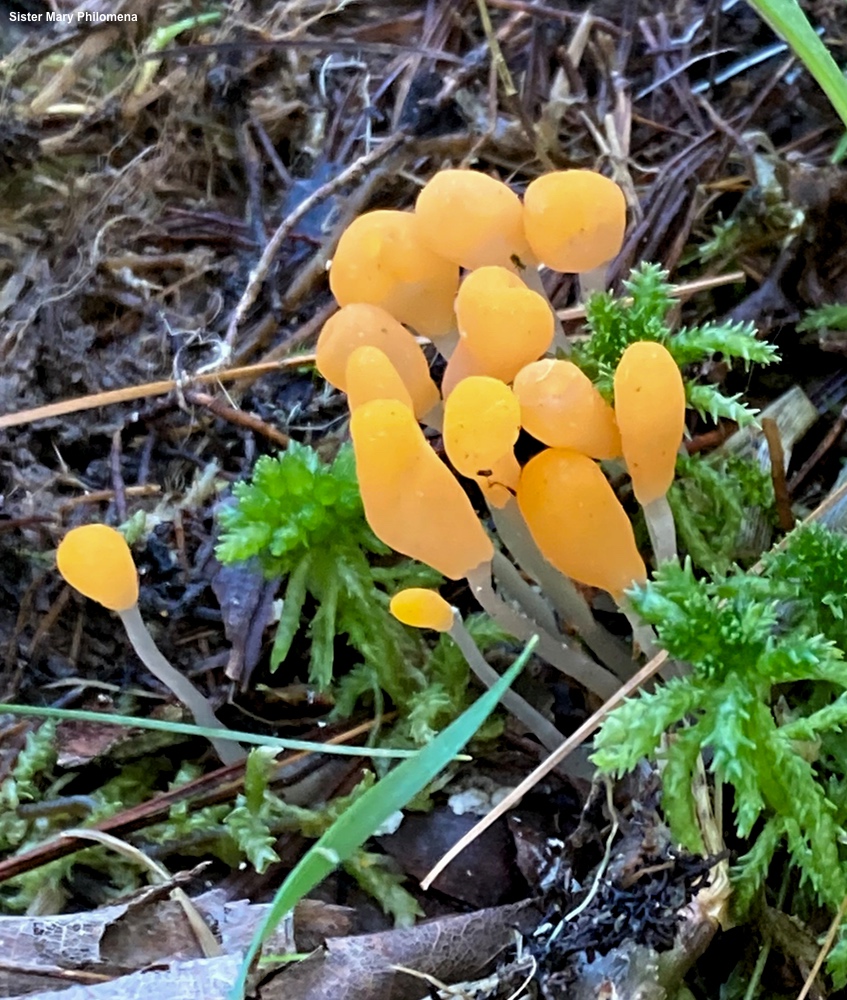
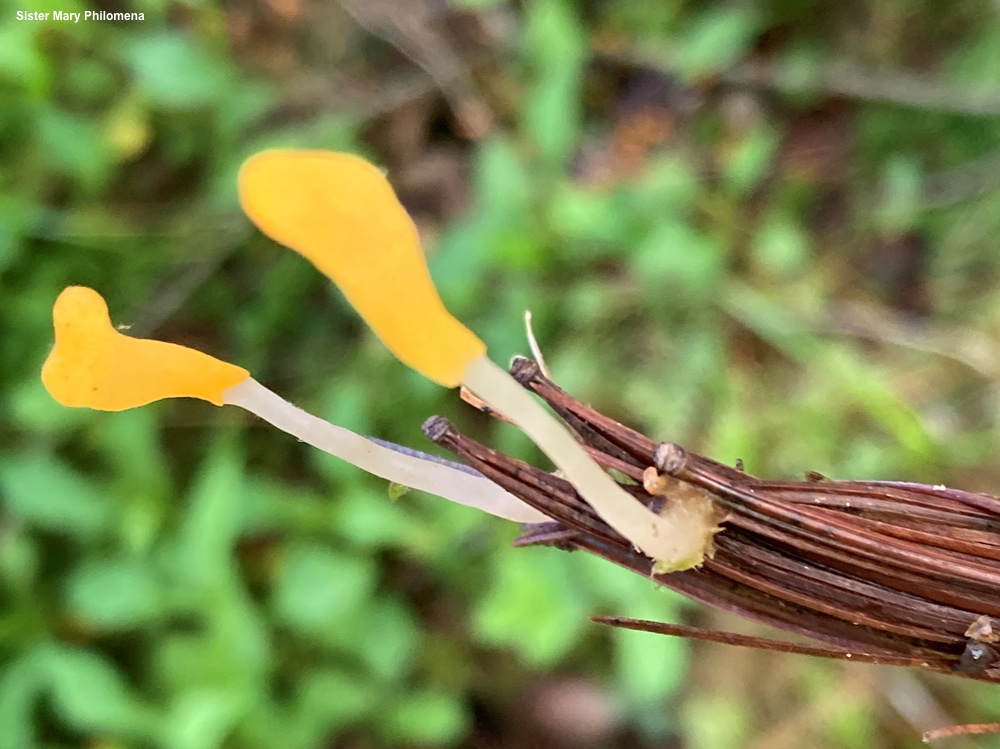
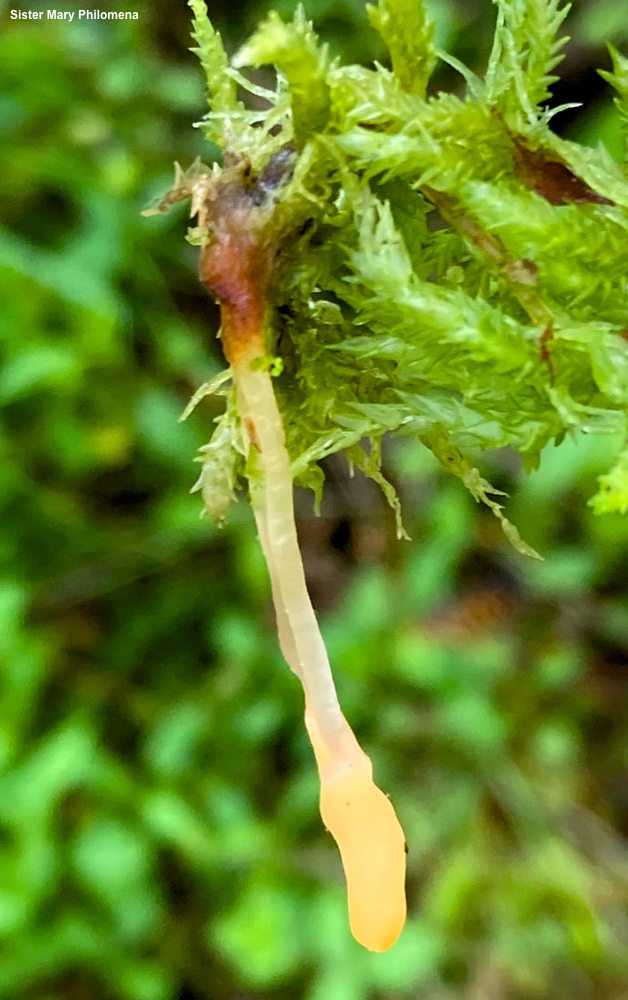
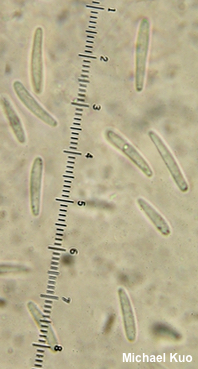
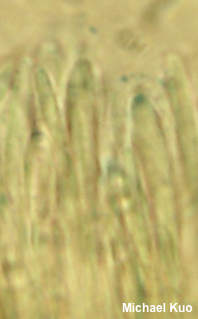
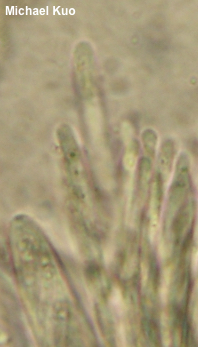
[ Ascomycota > Helotiales > Mitrulaceae > Mitrula ... ] Mitrula elegans by Michael Kuo, 20 July 2026 Sometimes called the "swamp beacon," this is a bucket-list mushroom for many collectors, myself included. It appears in spring, in swampy areas, often arising from water-soaked forest debris in standing pools. I have searched such areas many times, without success—but, fortunately, my mushroom correspondent Sister Mary Philomena, O. P., found Mitrula elegans this year, and sent me her collection for study. Dried for the herbarium, the little mushrooms look pretty much like they do in the fresh state, featuring an orangish yellow head atop a fragile, whitish stem. Under the microscope, Mitrula elegans has funky, cylindric spores and amyloid ascus tips. The similar Mitrula borealis is distributed north of the Great Lakes and can be separated on the basis of its wider spores, which often feature a gelatinous sheath, and its paler yellow color. Mitrula lunulatospora has a pinkish head and wider spores that are frequently curved into crescent moon shapes. Mitrula paludosa is a virtually identical European species; its name was applied to Mitrula elegans by many authors in the 20th century. Thanks to Sister Mary Philomena, O. P., for documenting, collecting, and preserving Mitrula elegans for study; her collection is deposited in The Herbarium of Michael Kuo. Description: Ecology: Saprobic; growing gregariously on leaf and needle litter in wet places (swamps, pools in low woods, sphagnum bogs, or melting snowbanks); usually found in spring and early summer; originally described from "USA" (Berkeley 1846) with the precise location unspecified (but probably in the Boston area); widely distributed in the United States and Canada but rare or absent in the Rocky Mountains. The described and illustrated collection is from New York. Fruiting Body: Club-shaped, with a well defined head that is clearly separate from the stem; 2–4 cm high. Head: 3–6 mm wide; irregular in shape but often more or less club-shaped; bald; moist or a little gelatinous; orangish yellow to yellowish orange. Stem: up to 25 mm long; 1–2 mm wide; bald; translucent whitish to grayish; basal mycelium yellow, becoming rusty brown. Flesh: Insubstantial. Odor: Not distinctive. Microscopic Features: Spores 9–14 x 1–2 µm; cylindric or subcylindric; often slightly curved; smooth; aseptate or with one septum; hyaline in KOH; inamyloid. Asci 8-spored; to 100 x 6 µm; narrowly fusiform; extreme apices amyloid. Paraphyses 1.5–2 µm wide; filiform, with apices slightly subacute, or merely rounded; smooth; hyaline in KOH. REFERENCES: M. J. Berkeley, 1846, 1875. (Smith, 1949; Seaver, 1951; Mains, 1955; Redhead, 1977; Smith, Smith & Weber, 1981; Lincoff, 1992; Barron, 1999; Wang et al., 2005; McNeil, 2006; Thormann & Rice, 2007; Trudell & Ammirati, 2009; Beug et al., 2014; Desjardin, Wood & Stevens, 2015; Baroni, 2017; Elliott & Stephenson, 2018; Sturgeon, 2018; Siegel et al., 2019; MacKinnon & Luther, 2021; McKnight et al., 2021.) Herb. Kuo 06012601. This website contains no information about the edibility or toxicity of mushrooms. |
© MushroomExpert.Com |
|
Cite this page as: Kuo, M. (2026, June). Mitrula elegans. Retrieved from the MushroomExpert.Com Web site: http://www.mushroomexpert.com/mitrula_elegans.html |