| Major Groups > Saddles > Helvella fallax |

|
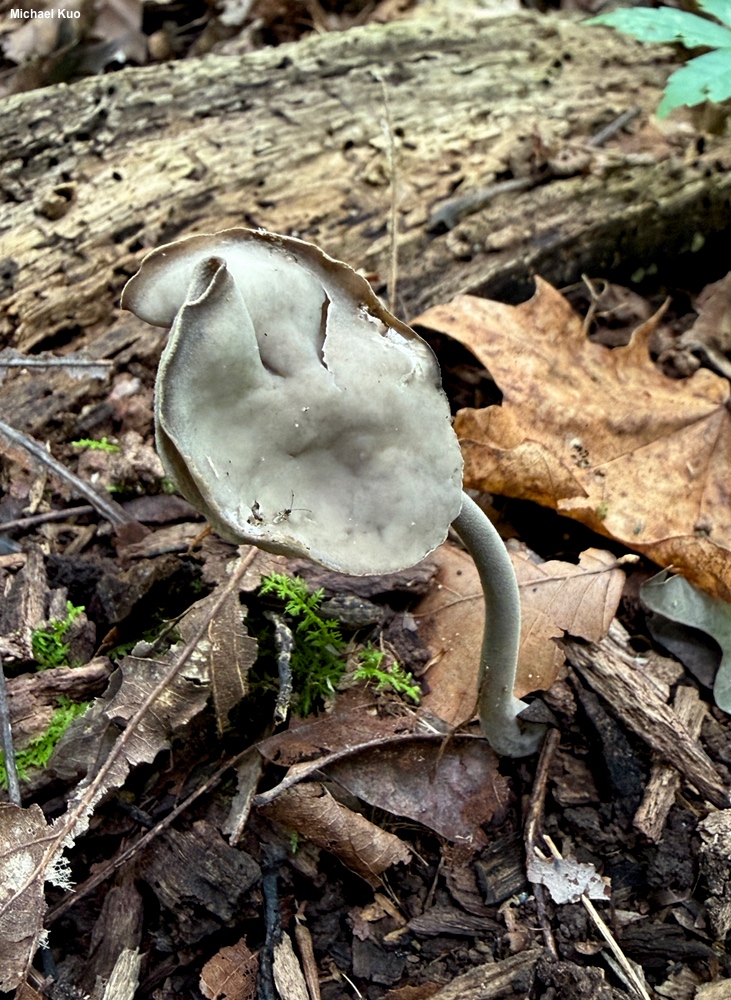
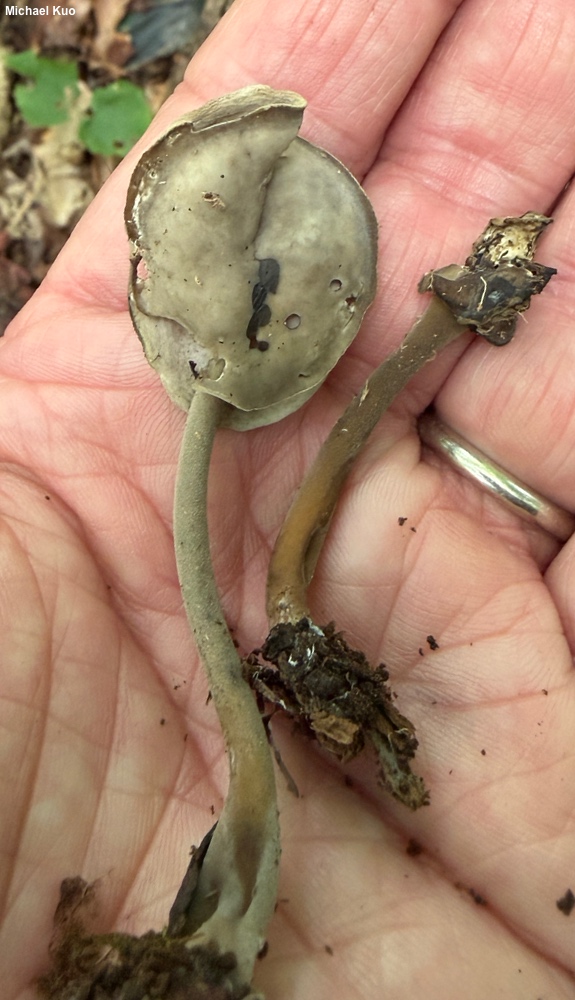
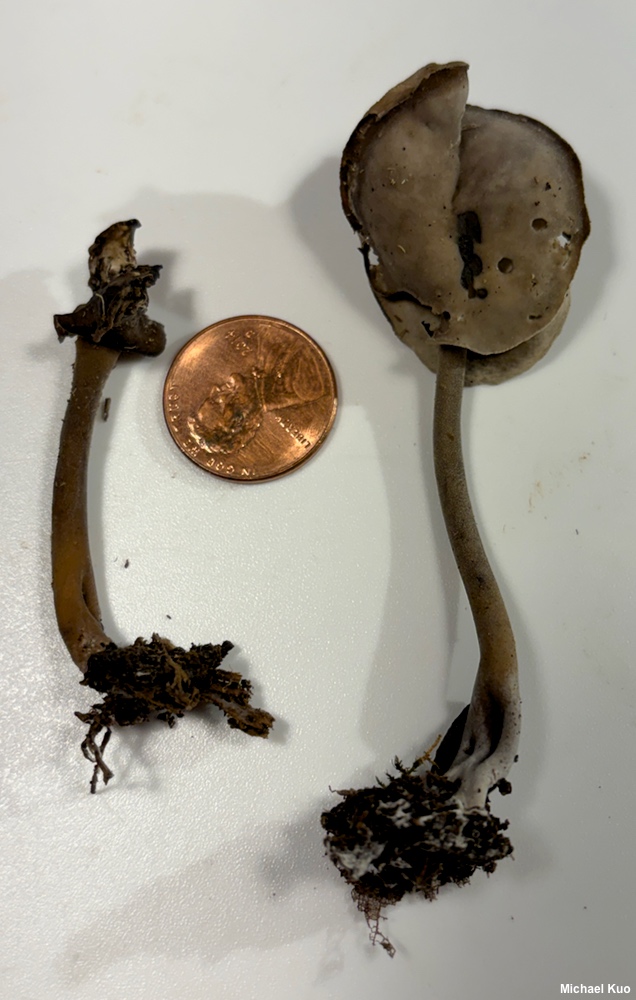
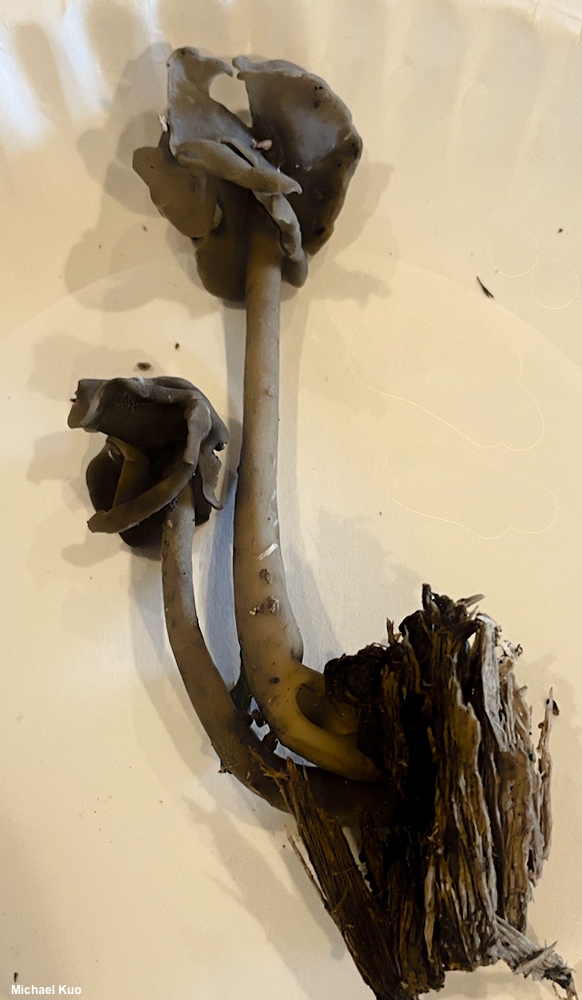
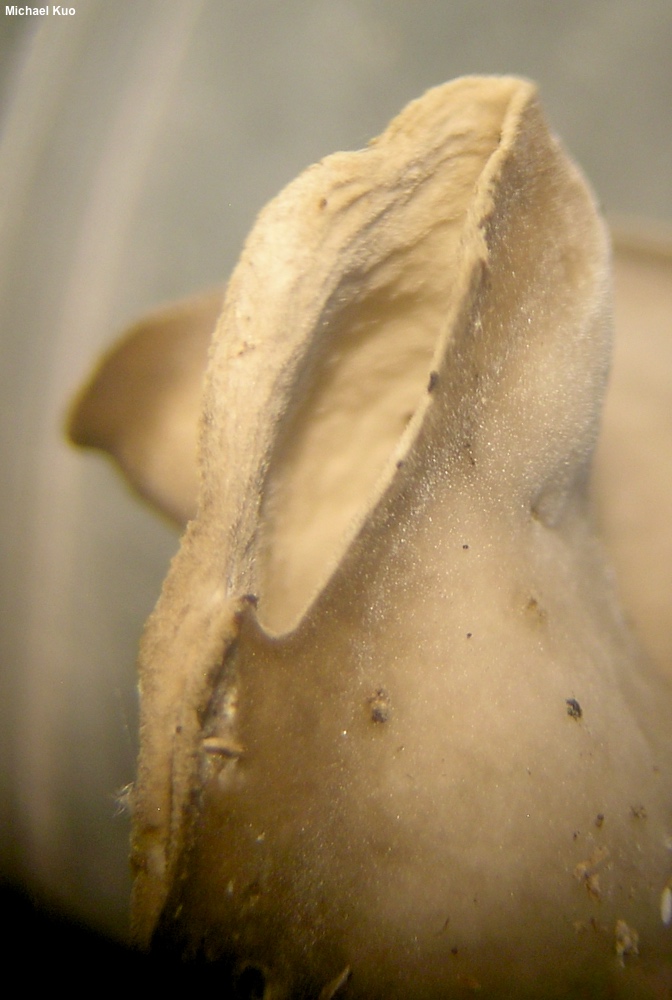
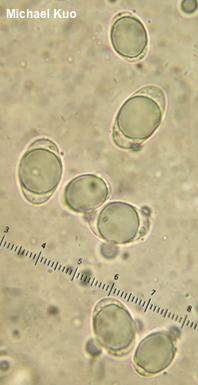
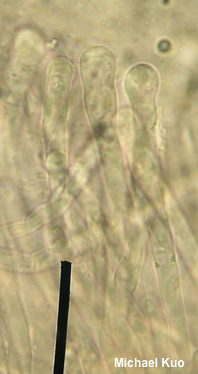
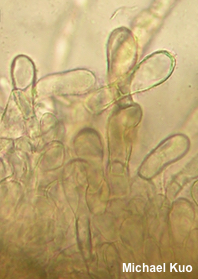
[ Ascomycota > Pezizales > Helvellaceae > Helvella . . . ] Helvella fallax by Michael Kuo, 31 July 2026 Helvella fallax is a small, saddle-shaped Helvella from Europe, North America, and Asia with somber, gray to black colors and a narrow, round stem that lacks ribs. It is similar to Helvella pezizoides, but that species has a cap that is saddle-shaped less frequently, and usually features a rolled up edge; additionally, Helvella pezizoides has a densely fuzzy sterile surface, while the sterile surface of Helvella fallax is only slightly fuzzy. Elvella atra, Leptopodia atra, and Helvella atra are synonyms—and the latter name was widely used until Skrede et al. (2017) disentangled more than two centuries of misapplications of the name, revealing the true Helvella atra to be a member of the Helvella lacunosa species complex, with more irregular cap shapes and deeply ridged and pocketed stems. Helvella pulla and Helvella subglabra are taxonomic synonyms, representing putative species with approximately 1 percent phylogenetic divergence (assessed via branch lengths in phylogenies presented in Skrede et al. 2017 and Skrede et al. 2023)—though the argument for separating Helvella pulla, with fairly consistent morphological and ecological differences (pulla is described as a paler shade of gray, arising from deadwood rather than soil) is more convincing than the argument for subglabra, with no significant morphological, ecological, or distributional differences. Description: Ecology: Possibly mycorrhizal; often reported under oaks, but also reported under conifers and in mixed conifer-harwood forests; growing alone or gregariously from the ground or from deadwood; summer and fall; originally described from France (Quélet 1876), with a recent epitype from France (Skrede et al. 2017); widely distributed in Europe; in North America distributed east of the Rocky Mountains and in Mexico; also documented in Japan. The illustrated and described collections are from Ohio. Cap: 2.5–3 cm across and 3–4 cm high; usually narrowly saddle shaped with two high lobes, and somewhat flattened or two-dimensional, but occasionally irregularly lobed or convoluted; fertile surface bald, gray; sterile undersurface very finely fuzzy (use a hand lens) or nearly bald, pale gray. Stem: 50–70 x 3–4 mm; equal; dark gray to gray; bald; smooth and unribbed; round in cross-section; basal mycelium white. Flesh: Thin; brittle; grayish. Odor: Not distinctive. Microscopic Features: Spores 11–19 x 9–11 µm; broadly ellipsoid; smooth; with one oil large droplet; hyaline in KOH. Asci 230 x 12.5 µm; 8-spored. Paraphyses 3–6 µm wide; cylindric, with subclavate, subcapitate, tapered, slightly irregular, or merely rounded apices; smooth; hyaline to grayish in KOH. Excipular surface a palisade of chained elements 8–18 µm; wide, smooth or rarely slightly roughened, hyaline or occasionally with brownish walls in KOH; terminal cells raging from cylindric to clavate or obpyriform; subterminal cells sometimes wider than terminal cells. REFERENCES: L Quélet, 1877. (Seaver, 1928; Dissing, 1964; Dennis, 1968; Kempton & Wells, 1970; Weber, 1972; Breitenbach & Kränzlin, 1984; Arora, 1986; Abbott & Currah, 1988; Roody, 2003; Spooner, 2003; López & García, 2005; Buczacki et al., 2012; Landeros & Guzmán-Dávalos, 2013; Beug et al., 2014; Landeros et al., 2015; Skrede et al., 2017; Læssøe & Petersen, 2019; Skrede et al., 2023.) Herb. Kuo 07192501, 07242601. This site contains no information about the edibility or toxicity of mushrooms. |
© MushroomExpert.Com |
|
Cite this page as: Kuo, M. (2026, July). Helvella fallax. Retrieved from the MushroomExpert.Com Web site: http://www.mushroomexpert.com/helvella_fallax.html |