| Major Groups > Gilled Mushrooms > Pale-Spored > Waxy Caps > Cuphophyllus pratensis |

|
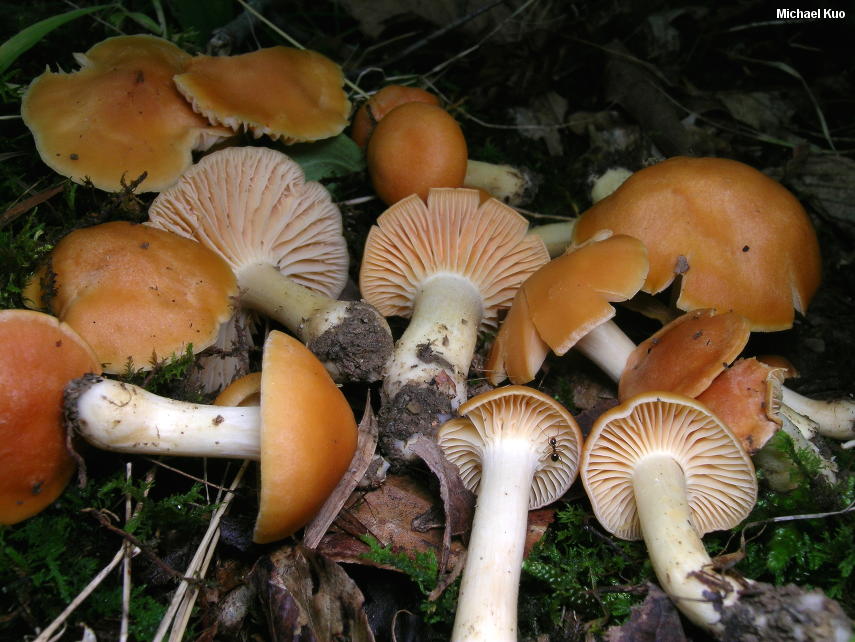
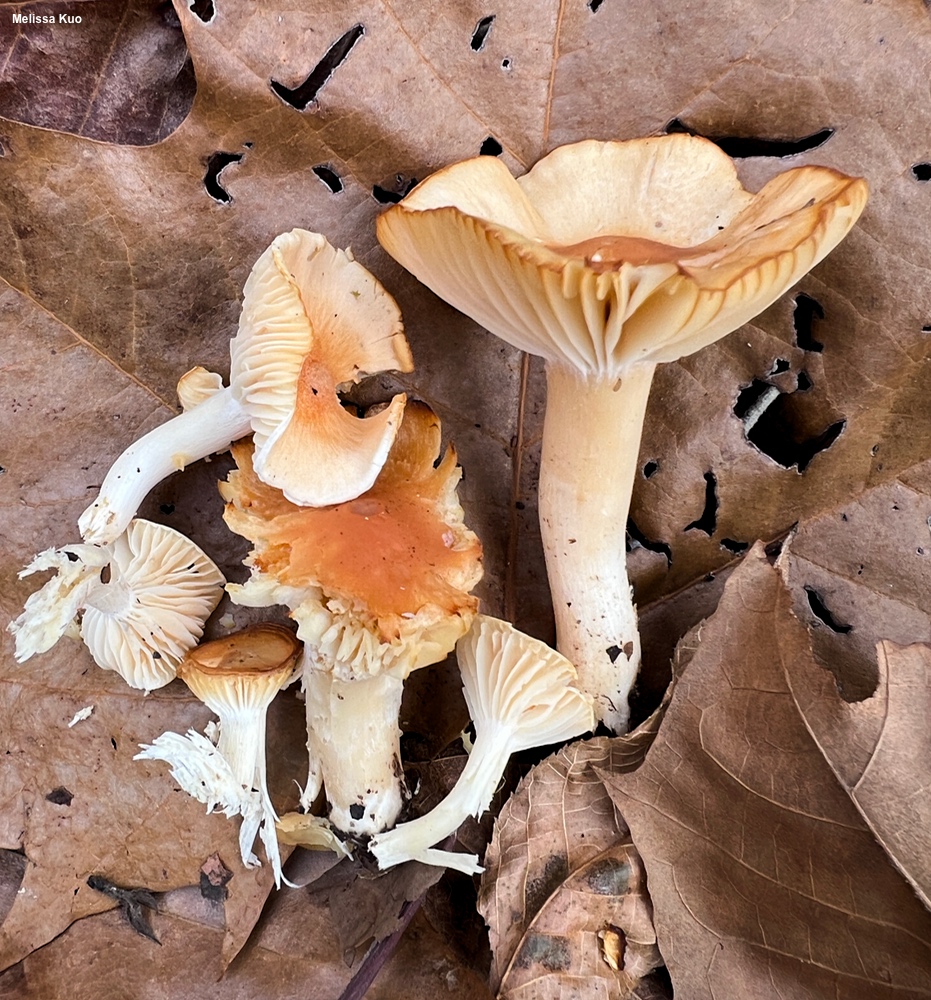
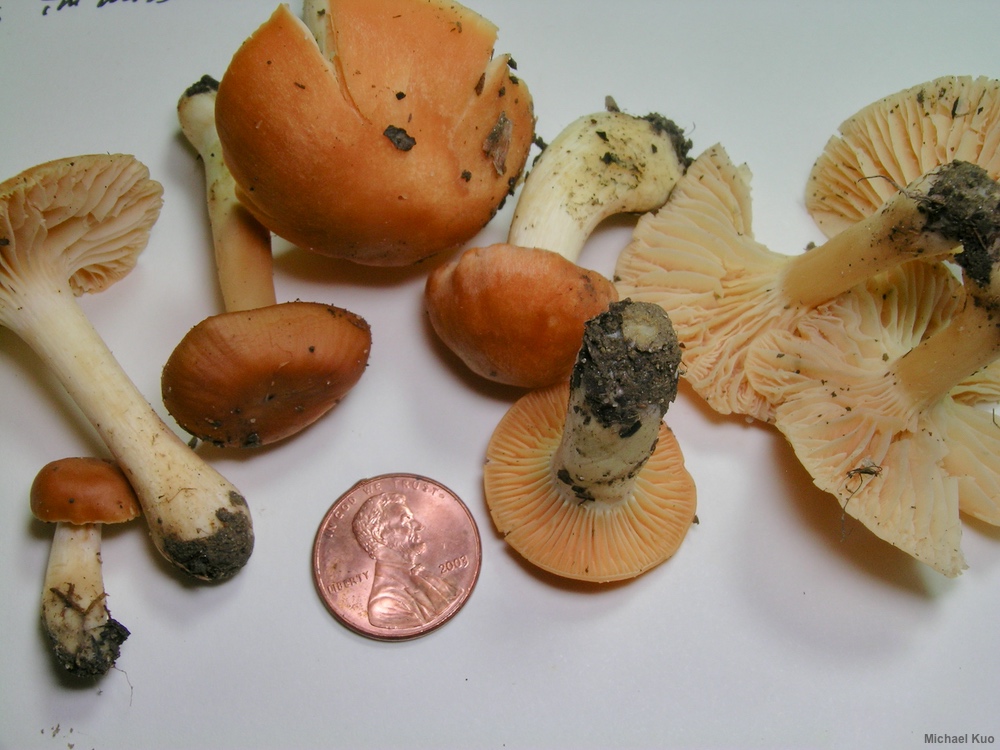
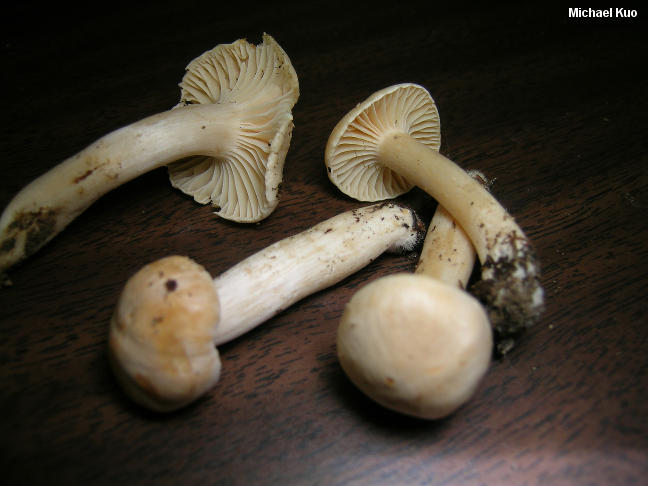
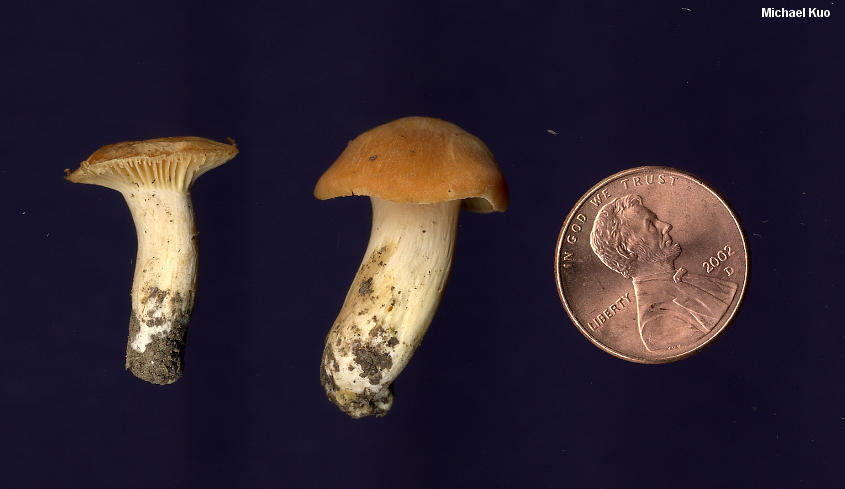
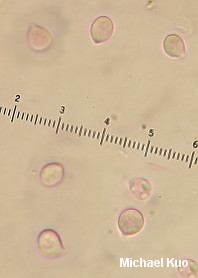
[ Basidiomycota > Agaricales > Hygrophoraceae > Cuphophyllus . . . ] Cuphophyllus pratensis by Michael Kuo, 17 September 2026 With its dry cap surface this waxy cap is less "waxy-cap-ish" than many others, but once you have placed it in the waxy cap family, it is fairly distinctive. Crucial identifying features include the dry, brownish orange to orangish buff cap, and the cream to orangish, distant gills that begin to run down the stem. The young caps are, in Mycologese, "appressed fibrillose" (covered with tiny, pressed-down fibers; use a hand lens), giving them a whitish sheen. Cuphophyllus pratensis has been shifted between several genera in the waxy cap family over the years, and your field guide may place the species in Hygrophorus, Camarophyllus, or Hygrocybe. Description: Ecology: Precise ecological role uncertain (see Lodge et al. 2013); growing scattered to gregariously in hardwood or conifer forests or in grass; late spring through fall (or over winter in warmer climates); originally described from Europe (Persoon 1801); widely distributed in Europe and North America. The illustrated and described collections are from California, Illinois, and Ohio. Cap: 2–6 cm; convex when young, becoming broadly convex to nearly flat; dry, or slightly tacky when fresh; covered with very tiny, pressed-down fibers (use a hand lens), at least when young—but often more or less bald by maturity; dull brownish orange, fading to orangish buff; the margin not lined. Gills: Running slightly down the stem; distant or nearly so; creamy orangish or nearly whitish; short-gills frequent; often with cross-veins by maturity. Stem: 2.5–5.5 cm long; 0.5–1 cm thick; fairly equal; bald; dry; creamy orangish to whitish; white at the base. Flesh: Whitish; unchanging when sliced. Odor and Taste: Odor not distinctive, or sometimes slightly foul and unpleasant; taste not distinctive. Chemical Reactions: KOH negative to greenish on cap surface. Spore Print: White. Microscopic Features: Spores 5–8 x 4–6 µm; broadly ellipsoid, sublacrymoid, or subglobose; smooth; hyaline in KOH; inamyloid. Basidia 40–52 x 5–7 µm; subclavate; 4-sterigmate. Hymenial cystidia not found. Lamellar trama interwoven. Pileipellis a cutis. REFERENCES: (Persoon, 1801) Bon, 1985. (Fries, 1821; Murrill, 1914; Kauffman, 1918; Hesler & Smith, 1963; Bird & Grund, 1979; Smith, Smith & Weber, 1979; Phillips, 1981; Moser, 1983; Largent, 1985; Arora, 1986; Arnolds, 1990; Breitenbach & Kränzlin, 1991; Phillips, 1991/2005; Lincoff, 1992; Candusso, 1997; Barron, 1999; Boertmann, 2000; Roody, 2003; McNeil, 2006; Nonis, 2007; Boccardo et al., 2008; Trudell & Ammirati, 2009; Boertmann, 2010; Bessette et al., 2012; Buczacki et al., 2012; Lodge et al., 2013; Kuo & Methven, 2014; Desjardin, Wood & Stevens, 2015; Siegel & Schwarz, 2016; Baroni, 2017; Gminder & Böhning, 2017; Boertmann, 2018; Elliott & Stephenson, 2018; Læssøe & Petersen, 2019; Kibby, 2020; Wood & Dunkelman, 2020; McKnight et al. 2021.) Herb. Kuo 06120302, 01150514, 09221202, 11152503. This site contains no information about the edibility or toxicity of mushrooms. |
© MushroomExpert.Com |
|
Cite this page as: Kuo, M. (2026, September). Cuphophyllus pratensis. Retrieved from the MushroomExpert.Com Web site: http://www.mushroomexpert.com/cuphophyllus_pratensis.html |