| Major Groups > Boletes > Ridged/Pitted-Spored > Boletellus chrysenteroides |

|
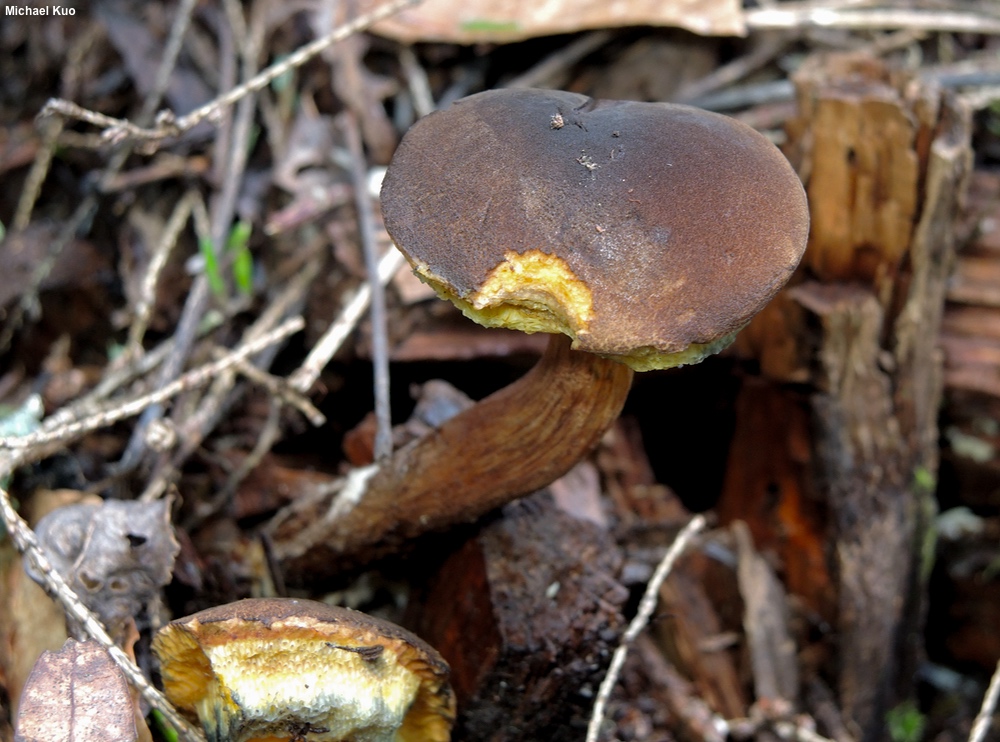
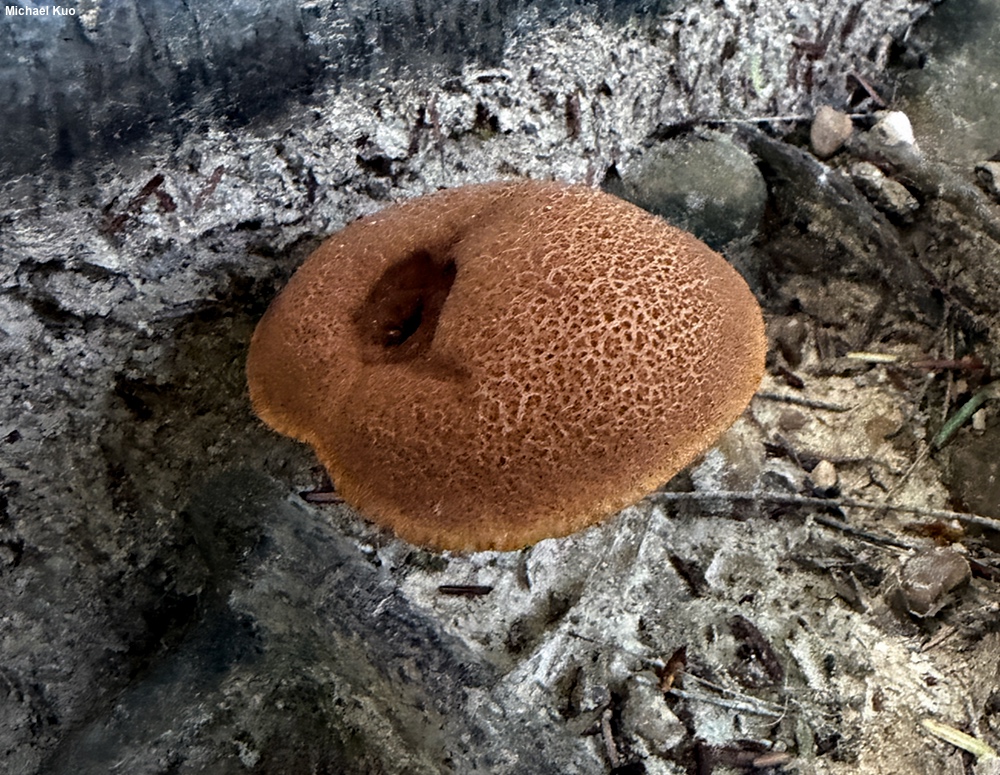
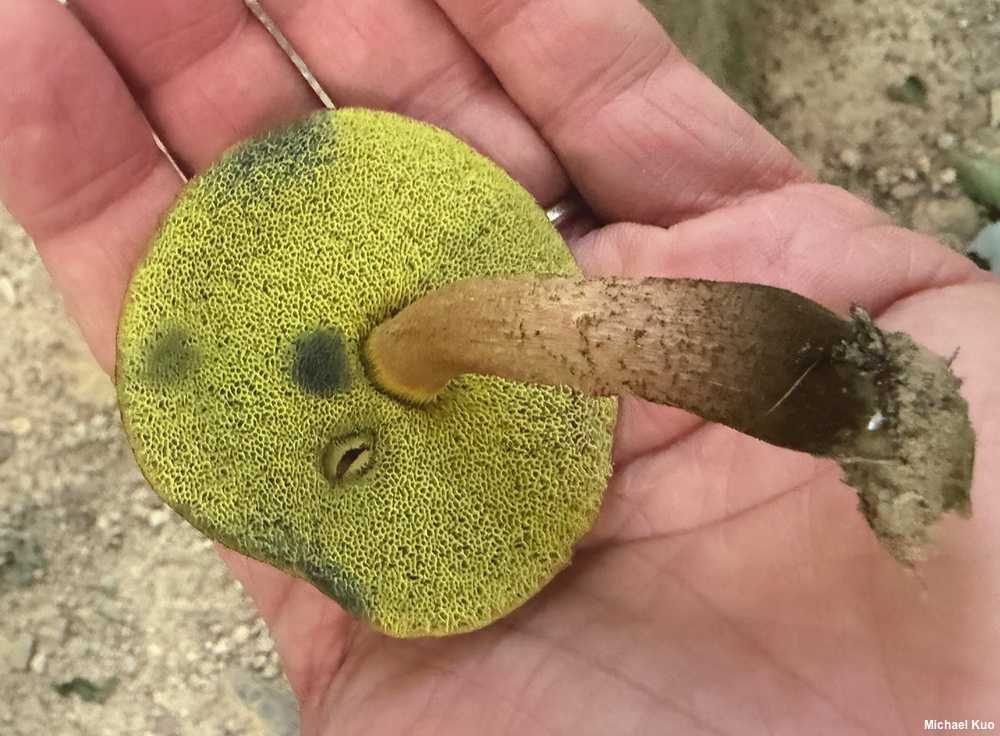
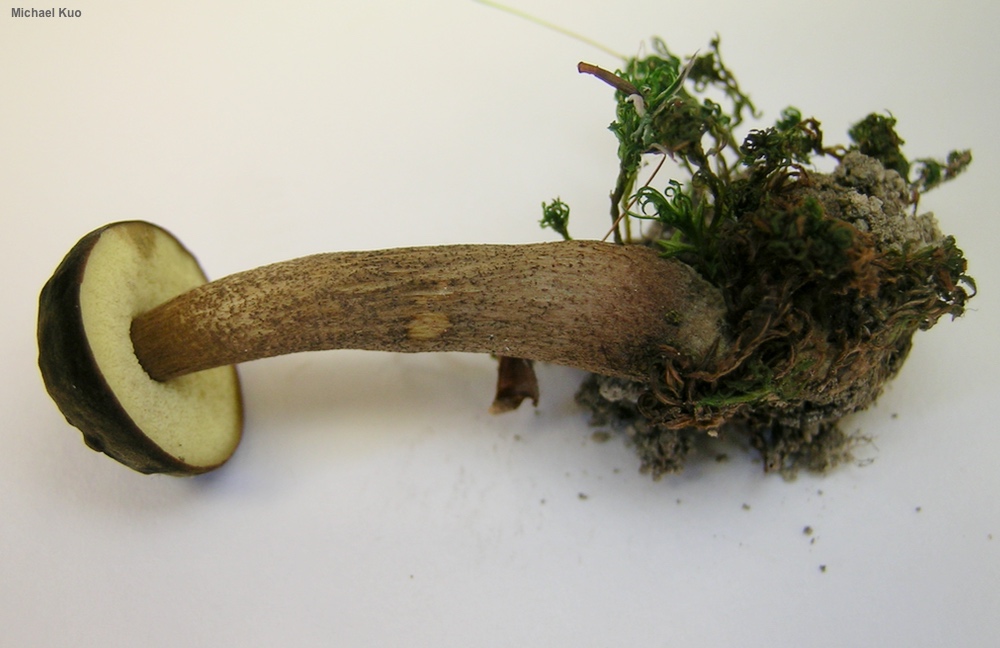
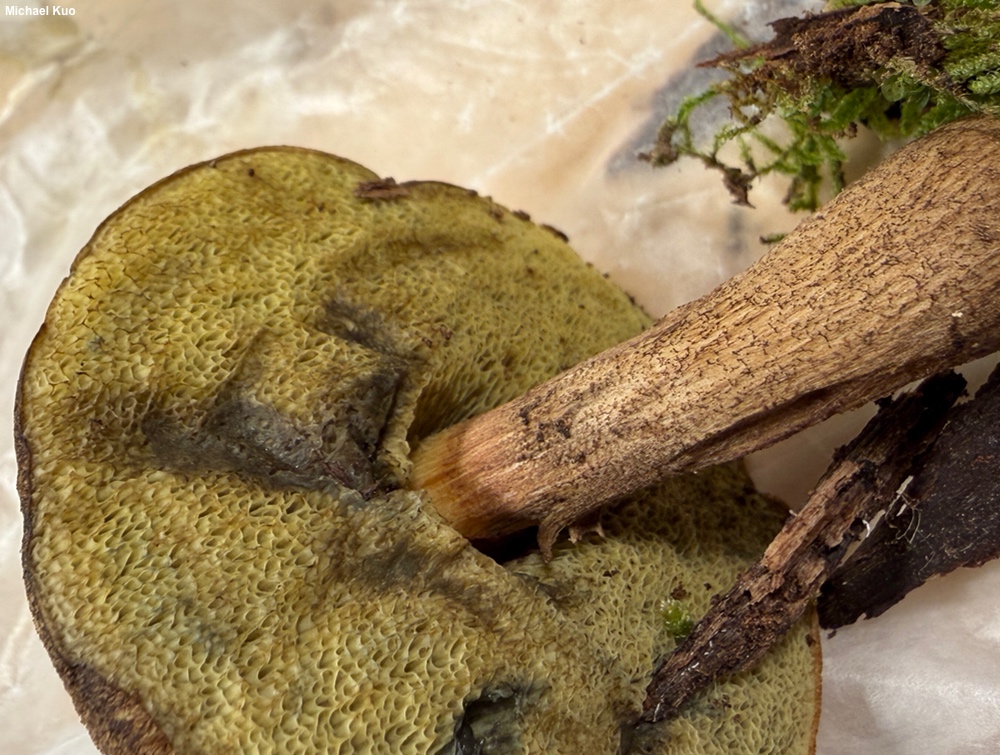
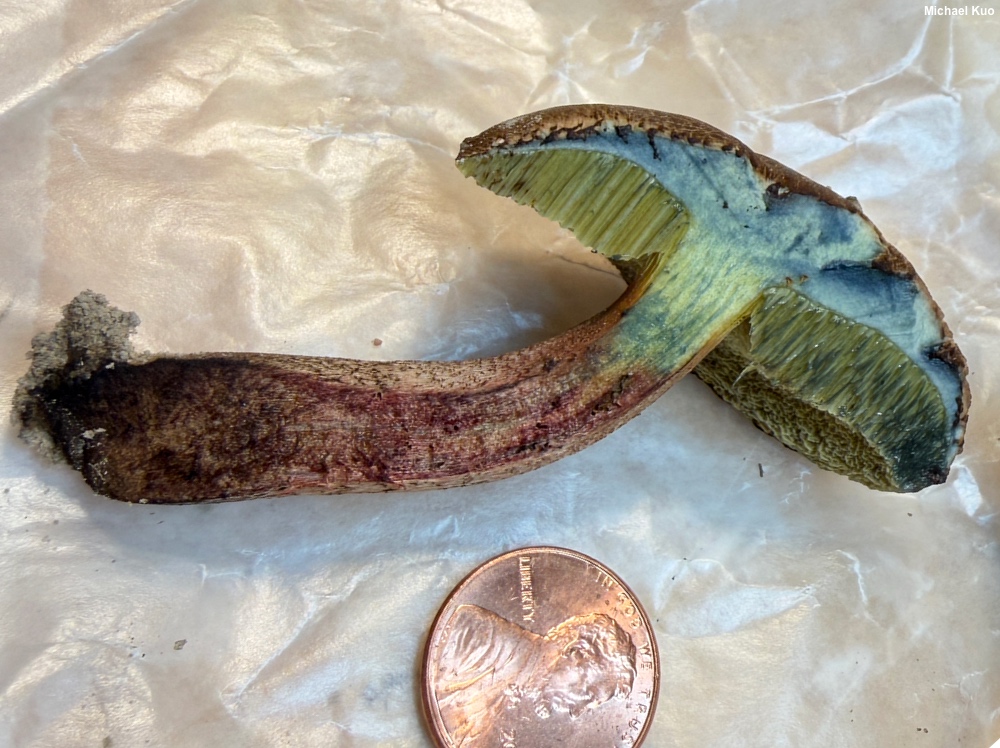
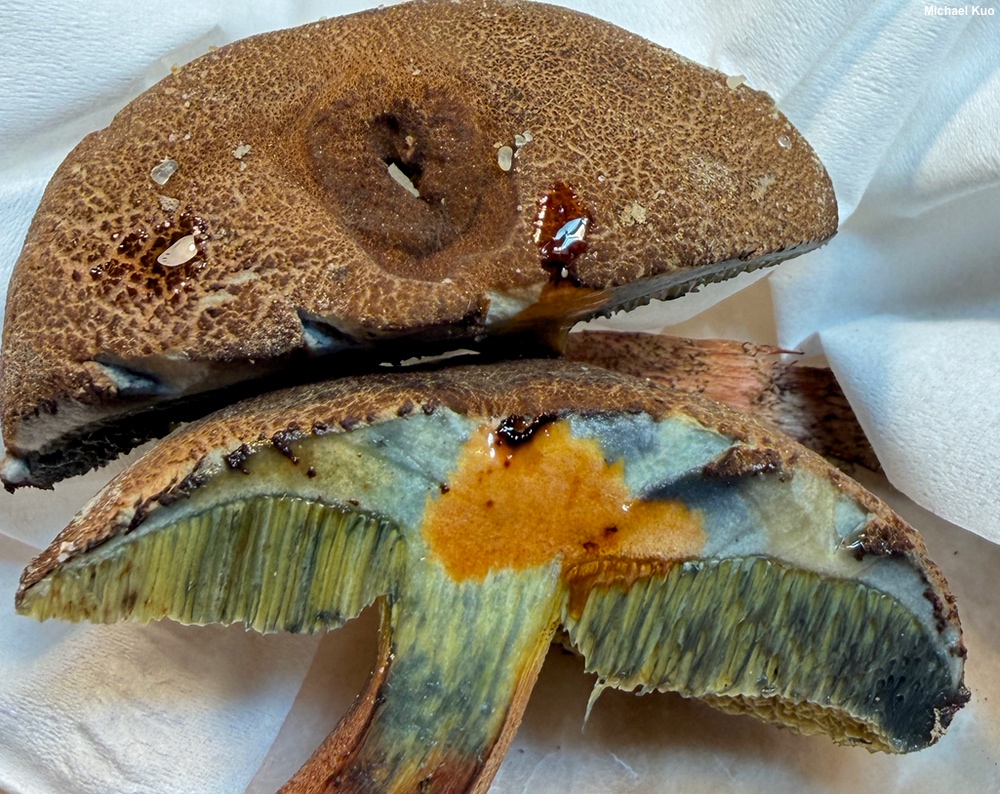
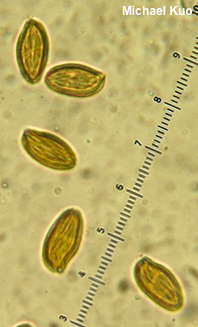
[ Basidiomycota > Boletales > Boletaceae > Boletellus . . . ] Boletellus chrysenteroides by Michael Kuo, 22 September 2026 Leccinum-like with its scaber-dotted stem, Xerocomellus chrysenteron-like in its areolate cap surface, and Boletellus-like in its longitudinally ridged spores, this fairly rare bolete can be downright confusing. And to confuse things even further, it likes to appear near (or even fruiting from) well decayed wood—behavior not typical of most boletes. Ultimately, however, the combination of all of these confusing features leads to fairly easy identification. Boletellus sinochrysenteroides is a synonym, although the study I am citing in support of this idea (Gelardi et al. 2026) reaches the opposite conclusion. However, the 5-gene phylogeny in the paper represents only minimal phylogenetic difference (much less than one percent) between Boletellus sinochrysenteroides and Boletellus chrysenteroides, and an Indiana collection of Boletellus chrysenteroides (mislabeled "chrysenteron" in the phylogram) groups with the Eurasian collections. Mexican collections of Boletellus chrysenteroides may represent Boletellus domingensis (Gelardi et al. 2026), a virtually identical species associated with pines and originally described from the Caribbean, clearly phylogenetically distinct (more than 10 percent) despite its morphological similarity. Description: Ecology: Mycorrhizal (Tedersoo et al. 2010) with oaks, but often found growing from or near well decayed stumps and logs; often found in forests where oaks are mixed with conifers; usually growing alone; summer and fall; originally described from New York (Snell 1936); widely distributed in North America east of the Great Plains, south through Texas and into Mexico; also present, as "Boletellus sinochrysenteroides," in China and Russia (see discussion above). The illustrated and described collections are from Ohio. Cap: 3–6 cm; convex, becoming broadly convex; dry; finely velvety to nearly bald; often becoming cracked with age; dark brown to nearly black at first, becoming medium brown or eventually pale brown. Pore Surface: Bright to dull yellow, becoming olive yellow; bruising grayish blue to blue, and eventually brown; 1-2 angular pores per mm; tubes to about 1 cm deep. Stem: 4–7 cm long; up to 1 cm thick; more or less equal; at first punctuated by brownish, Leccinum-like scabers that later become aggregated into hairy or sub-scaly clusters that sometimes approximate the appearance of reticulation; yellowish to brownish at first, sometimes becoming reddish in the mid-portion and dark brown toward the base with age; basal mycelium white. Flesh: Pale yellow to whitish, or with age reddish in the mid-portion of the stem and around damaged areas; changing to bluish or blue when sliced. Odor and Taste: Not distinctive. Chemical Reactions Ammonia pink or negative on cap; negative on flesh. KOH red on cap; orange on flesh. Iron salts negative on cap; negative or grayish on flesh. Microscopic Features: Spores 10–15 x 5–7 µm; elongated-ellipsoid; longitudinally striate; dull golden in KOH. Tube trama parallel. Basidia 23–25 x 9–10 µm; clavate; 4-sterigmate. Hymenial cystidia 45–55 x 7–8 µm; fusiform to lageniform; smooth; thin-walled; hyaline in KOH. Pileipellis a palisadoderm; elements 9–12 µm wide, smooth, hyaline to brownish in KOH; terminal cells abruptly tapered; subterminal cells occasionally swollen. REFERENCES: (W. H. Snell, 1936) W. H. Snell, 1941. (Coker & Beers, 1943; Singer, 1945; Snell & Dick, 1970; Smith & Thiers, 1971; Grund & Harrison, 1976; Smith, Smith & Weber, 1981; Weber & Smith, 1985; Both, 1993; Barron, 1999; McNeil, 2006; Tedersoo et al., 2010; Kuo & Methven, 2014; Bessette et al., 2016; Baroni, 2017; Ayala-Vásquez et al. 2018; Sturgeon, 2018; McKnight et al., 2021; Gelardi et al., 2026.) Herb. Kuo 07171008, 07151605, 09042601. This site contains no information about the edibility or toxicity of mushrooms. |
© MushroomExpert.Com |
|
Cite this page as: Kuo, M. (2026, September). Boletellus chrysenteroides. Retrieved from the MushroomExpert.Com Web site: http://www.mushroomexpert.com/boletellus_chrysenteroides.html |