Key to 20 Laccaria Species in North America 
| 2. | Associated with live oak (Quercus virginiana) on the Gulf Coast; spores under 10 µ long. | |
| 2. | Not growing with live oak on the Gulf Coast; spores much longer than 10 µ. | 3 |
| 3. | Known only from eastern Canada; basal mycelium whitish; spores with clearly defined spines. | |
| 3. | Known from eastern North America and the Great Lakes region; basal mycelium purplish; spores roughened but without clearly defined spines. | |
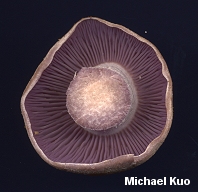
| 4. | Gills clearly purple (like, purple purple) when fresh, and usually remaining so as the mushroom matures. | 5 |
| 4. | Gills variously colored (vinaceous, flesh-colored, lilac, pinkish, etc.) but not clearly purple--or if pale purplish when young, soon fading to pinkish, flesh color, etc. | 8 |
| 5. | Growing in western North America under conifers. | |
| 5. | Growing east of the Rocky Mountains, under hardwoods or conifers. | 6 |
| 6. | Mature cap over 4 cm across, purplish when young but soon buff, whitish, or pale brownish; stem as wide as 2-3 cm when mature. | |
| 6. | Mature cap smaller than 4 cm across, variously colored; stem 1 cm wide or less when mature. | 7 |
| 7. | Associated with live oak (Quercus virginiana) on the Gulf Coast; cap purplish becoming brownish. | |
| 7. | Associated with oaks or beech in eastern North America; cap purple, fading to lilac or buff. | |
| 8. | Associated with eucalyptus; cap 1-3.5 cm across, rusty reddish brown, fading to buff, faintly to moderately lined; stem 2-6 cm long; basidia 2-spored. | |
| 8. | Not completely as above. | 9 |
| 9. | Mature cap under 3 cm across, strongly lined; stem less than 4 mm thick. | 10 |
| 9. | Mature cap usually larger than above, lined or not; stem usually thicker than above. | 16 |
| 10. | Stem 2-7 cm long, reddish brown, contrasting with paler overall color of mature cap. | |
| 10. | Stem shorter than above, colored more or less like the cap. | 11 |
| 11. | Growing under conifers, birches, or willows in arctic, boreal, or montane (near the tree line) areas. | 12 |
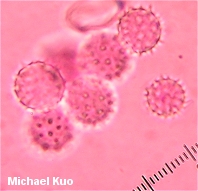
| 13. | Spores mostly elliptical, 8-10 x 7-8.5 µ, with spines about 1 µ long. | |
| 13. | Spores mostly subglobose, 9-10 x 8.5-9 µ, with spines about 2 µ long. | |
| 14. | Young cap with a wine-colored tinge that soon fades to reddish brown or orangish brown; basidia 2-spored; spores 10-15 µ long. | |
| 14. | Young cap reddish brown or orangish brown, without a wine-colored tinge; basidia 4-spored; spores 8-9 µ long. | 15 |
| 15. | Spores with spines about 1 µ wide at the base; cap usually not strongly lined. | |
| 15. | Spores with spines featuring wide (> 1 µ) bases; cap often strongly lined. | |
| 16. | Growing under hardwoods with no conifers nearby; not growing in sphagnum. | |
| 16. | Growing under conifers, or growing in sphagnum. | 17 |
| 17. | Basal mycelium of fresh, young specimens lilac to purplish--though possibly soon fading to whitish. | 18 |
| 17. | Basal mycelium white in all stages of development. | 21 |
| 18. | Found under long-leaf pine (Pinus palustris) along the Gulf Coast; cap sometimes with purplish tones; spores elliptical, with spines under 1 µ long. | |
| 18. | Not completely as above. | 19 |
| 19. | Cap and stem conspicuously scaly; cheilocystidia always absent. | |
| 19. | Cap and stem usually smooth, hairy, or finely scaly--but not conspicuously scaly on a regular basis; cheilocystidia usually present. | 20 |
| 20. | Cap pinkish to flesh-colored; cap surface with numerous but scattered perpendicular fascicles of interwoven hyphae. | |
| 20. | Cap brownish orange to reddish brown, fading to buff; cap surface, at least over the disc, densely packed with perpendicular fascicles of interwoven hyphae, appearing nearly as a trichoderm. | |
| 21. | Stem 7-14 cm long; growing in moss or sphagnum, usually with spruce, tamarack, or alder nearby. | |
| 21. | Stem shorter than above; usually not growing in moss or sphagnum but, if so, with pines nearby. | 22 |
| 22. | Spores round or nearly so, with spines 1-2 µ long; cap usually orangish brown, usually smooth or very finely hairy, usually under 5 cm across. | |
| 22. | Spores broadly elliptical, with spines .5-1 µ long; cap reddish brown to orangish brown, finely hairy becoming finely scaly with maturity, 2-7 cm across. | |
References
Fries, N. & G. M. Mueller (1984). Incompatibility systems, cultural features and species circumscriptions in the ectomycorrhizal genus Laccaria (Agaricales). Mycologia 76: 633–642.
Martin, F. et al. (2008). The genome of Laccaria bicolor provides insights into mycorrhizal symbiosis. Nature 452: 88–92.
Mueller, G. M. (1984). New North American species of Laccaria (Agaricales). Mycotaxon 20: 101–116.
Mueller, G. M. (1987). Designation of type collections for Laccaria proxima, L. tortilis, and L. trullissata. Mycotaxon 28: 303–311.
Mueller, G. M. (1991). Laccaria longipes, a new North American species of the Laccaria laccata complex. Mycotaxon 40: 145–150.
Mueller, G. M. (1991). Laccaria laccata complex in North America and Sweden: Intercollection pairing and morphometric analyses. Mycologia 83: 578–594.
Osmundson, T. W., C. L. Cripps & G. M. Mueller (2005). Morphological and molecular systematics of Rocky Mountain alpine Laccaria. Mycologia 97: 949–972.
Vellinga, E. (1995). Laccaria. In Bas, C., Th. W. Kuyper, M. E. Noordeloos & E. C. Vellinga. Flora Agaricina Neerlandica. Volume 3. Rotterdam: A. A. Balkema. 96-103.
© MushroomExpert.Com
This site contains no information about the edibility or toxicity of mushrooms.
Cite this page as:
Kuo, M. (2010, December). The genus Laccaria. Retrieved from the MushroomExpert.Com Web site: http://www.mushroomexpert.com/laccaria.html
|