Key to 13 Hypholomatoid Mushrooms in North America 
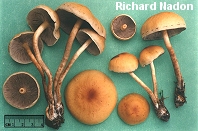
| 1. | Growing in woodchips; cap orange to orangish brown or reddish, stem orangish to yellow; stem with a "root" that is attached to an underground knot of tissue. | |
| 1. | Not normally growing in woodchips; cap varying; stem color varying; stem not attached to an underground knot of tissue. | 2 |
| 2. | Growing scattered or gregariously (not usually in clusters) on the ground, or in mosses, or on peat or muck; cap under about 3 cm across (rarely slightly larger). | 3 |
| 2. | Growing in clusters or densely gregariously (rarely alone or scattered), on wood or near deadwood (but occasionally growing from dead roots and appearing terrestrial); cap variously sized. | 10 |
| 3. | Stem with a well-developed, tapering, underground, rooting portion. | Hypholoma radicosum |
| 3. | Stem without a well-developed rooting portion. | 4 |
| 4. | Most spores 11 µm long or longer. | 5 |
| 4. | Most spores shorter than 11 µm. | 7 |
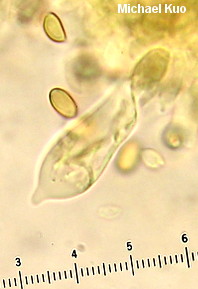
| 5. | Spores 14–18 µm long; cystidia developing irregular bumps and projections; probably southeastern in distribution. | Psilocybe longispora |
| 5. | Spores variously sized; cystidia not developing projections; distribution varying. | 6 |
| 6. | Spores 13–18 µm long, with small germ pore. | Bogbodia udua |
| 6. | Spores 11–14 µm; long, with large germ pore. | Hypholoma ericaeum |
| 7. | Most spores 7–9 µ long. | Hypholoma polytrichi |
| 7. | Most spores 9–11 µ long. | 8 |
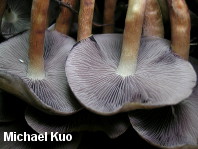
| 8. | Mature gills dark purplish brown. | Psilocybe squalidella |
| 8. | Mature gills dull brown to yellowish brown. | 9 |
| 9. | Fresh cap with olive shades; spores narrowly ellipsoid. | Psilocybe olivaceotincta |
| 9. | Fresh cap yellow; spores broadly ellipsoid. | Hypholoma elongatum |
| 10. | Fresh cap red to brick red; appearing on the deadwood of hardwoods. | |
| 10. | Fresh cap not red (or only slightly so over the center); usually associated with the deadwood of conifers (but rarely with the deadwood of hardwoods). | 11 |
| 11. | Gills greenish yellow when young, becoming smoky greenish with age; taste bitter. | 12 |
| 11. | Gills whitish, grayish, or dull yellowish when young, not developing greenish hues; taste usually not distinctive. | 13 |
| 12. | Mature cap 2–5 cm across; widely distributed in North America. | |
| 12. | Mature cap 1–3 cm across; known from the southeastern states and the Caribbean. | |
| 13. | Usually growing in clusters; mature caps 3–7 cm across, yellowish brown to cinnamon overall, with a slightly darker area over the center. | |
| 13. | Usually growing gregariously; mature caps 1–3 cm across, reddish brown with a thin, paler, marginal zone. | Hypholoma dispersum |
References
Antonín, V., J. Polčák & M. Tomšovský (2009). Hypholoma tuberosum, a new representative of the Czech and Central-European mycobiota. Mycotaxon 108: 41–47.
Nagasawa, E., Y. Shimono & T. Hongo (2000). The occurrence of Hypholoma tuberosum (Agaricales, Strophariaceae) in Japan. Reports of the Tottori Mycological Institute 38: 6–13.
Noordeloos, M. E. (1999). Psilocybe. In Bas, C., Th. W. Kuyper, M. E. Noordeloos & E. C. Vellinga (1999). Flora Agaricina Neerlandica: Critical monographs on families of agarics and boleti occurring in the Netherlands. Volume 4. Rotterdam: A. A. Balkema, 28–79.
Redhead, S. A. & P. Kroeger (1987). A sclerotium-producing Hypholoma from British Columbia. Mycotaxon 29: 457–465.
Sato, H., R. Ohta & N. Murakami (2020). Molecular prospecting for cryptic species of the Hypholoma fasciculare complex: toward the effective and practical delimitation of cryptic macrofungal species. Scientific Reports 10: 13224.
Smith, A. H. (1951). North American species of Naematoloma. Mycologia 43: 466–521.
Stamets, P. E. (1978). Psilocybe mushrooms and their allies. Seattle: Homestead Book Company. 160 pp.
Vesterholt, J. & E. Rald (2018). Hypholoma (Fr.) P. Kumm. In Knudsen, H. & J. Vesterholt, eds. Funga Nordica: Agaricoid, boletoid, clavarioid, cyphelloid and gastroid genera. Copenhagen: Nordsvamp. 942–946.
This website contains no information about the edibility or toxicity of mushrooms.
Cite this page as:
Kuo, M. (2020, October). The genus Hypholoma. Retrieved from the MushroomExpert.Com Web site: http://www.mushroomexpert.com/hypholoma.html
© MushroomExpert.Com