| Major Groups > False morels |

|
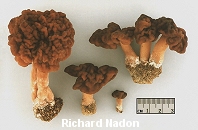
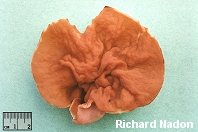
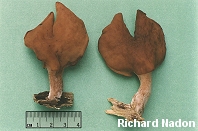
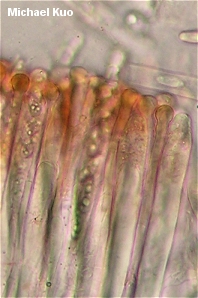
Gyromitra: The False Morels [ Ascomycetes > Pezizales > Discinaceae . . . ] by Michael Kuo Species in the genus Gyromitra vary widely in appearance. Some species are cup-shaped and have rudimentary stems (most of these were placed in the now-defunct genus Discina until recently). Other species are more familiar and are often collectively referred to as the "false morels." They have well developed stems, and their oddly shaped caps are generally reddish brown to yellowish brown. When sliced open, they are not completely hollow--and this is a good way to distinguish them from the true morels, which are hollow. DNA research by O'Donnell and collaborators (1997) placed Gyromitra in the Discinaceae family, and supported the idea that the cup-like species of Discina belong in Gyromitra--an idea previously put forth by several workers in pre-DNA days, based on microscopic similarities. The spores of Gyromitra and "Discina" species are similar, and paraphyses are characteristically filled with reddish to orangish or yellowish granular contents. Identification of Gyromitra species can usually be accomplished through careful observation of macroscopic physical features (primarily the shape and proportions of the cap and stem), but microscopic analysis of spores is sometimes required. In the latter case a tiny sliver of the cap surface should be crush mounted in water and/or KOH. Gyromitra species can be particularly difficult to preserve successfully, since they tend to blacken and cook during the drying process; I recommend low heat, lots of circulating air, and long drying times. A corollary problem is that dried specimens often require substantial rehydration in order to become workable; soak Gyromitra material in 90% alcohol for a minute or so, then in water for up to 20 minutes before attempting to section the material. The O'Donnell study did not attempt to resolve taxonomic questions at the species level. Thus, since the false morels are poorly known in North America, the dozen or so species that have been named should in my view be seen as tentative indicators of potential species groups until they are more thoroughly documented and subjected to contemporary study. |
|

|
Key to 13 Species of Gyromitra in North America
References Abbott, S. O. & Currah, R. S. (1997). The Helvellaceae: Systematic revision and occurrence in northern and northwestern North America. Mycotaxon 62: 1-125. Batra, L. R. (1976). Helvella and Gyromitra (Pezizales: Operculatae) in the southern Appalachians. In B. C. Parker & M. K. Roane, eds. Distributional history of the biota of the southern Appalachians. Part IV. Algae & fungi: biogeography, systematics and ecology. Charlottesville, Virginia: University Press of Virginia. 145-204. Breitenbach, J. & Kränzlin, F. (1984). Fungi of Switzerland: A contribution to the knowledge of the fungal flora of Switzerland. Volume 1 Ascomycetes. Transl. Walters, V. L. & Walters, J. F. Lucern: Verlag Mykologia. 310 pp. Harmaja, H. (1969). A neglected species, Gyromitra ambigua (Karst.) Harmaja, n. comb., and G. infula s. str. in Fennoscandia. Karstenia 9: 13-19. Harmaja, H. (1973). Amendments of the limits of the genera Gyromitra and Pseudorhizina, with the description of a new species, Gyromitra montana. Karstenia 13: 48-58. Kanouse, B. B. (1946). Some studies in the genus Helvella. Papers of the Michigan Academy of Science, Arts and Letters 32: 83-90. Kuo, M. (2005). Morels. Ann Arbor: University of Michigan Press. McKnight, K. H. (1969). A note on Discina. Mycologia 61: 614-630. McKnight, K. H. (1973). Two misunderstood species of Gyromitra (false morel) in North America. The Michigan Botanist 12: 147-162. O'Donnell, K. O., et al. (1997). Phylogenetic relationships among ascomycetous truffles and the true and false morels inferred from 18S and 28S ribosomal DNA sequence analysis. Mycologia 89: 48-65. Raitviir, A. (1970). Once more on Neogyromitra caroliniana. Transactions of the Tartu State University 268, Papers on Botany 9: 364-373. Weber, N. S. (1995). A morel hunter's companion: A guide to true and false morels. Michigan: Thunder Bay Press. 209 pp. This website contains no information about the edibility or toxicity of mushrooms. Cite this page as: Kuo, M. (2012, June). Gyromitra: The false morels. Retrieved from the MushroomExpert.Com Web site: http://www.mushroomexpert.com/gyromitra.html © MushroomExpert.Com |